
Cross-Partnership Exchange on the Energy Transition
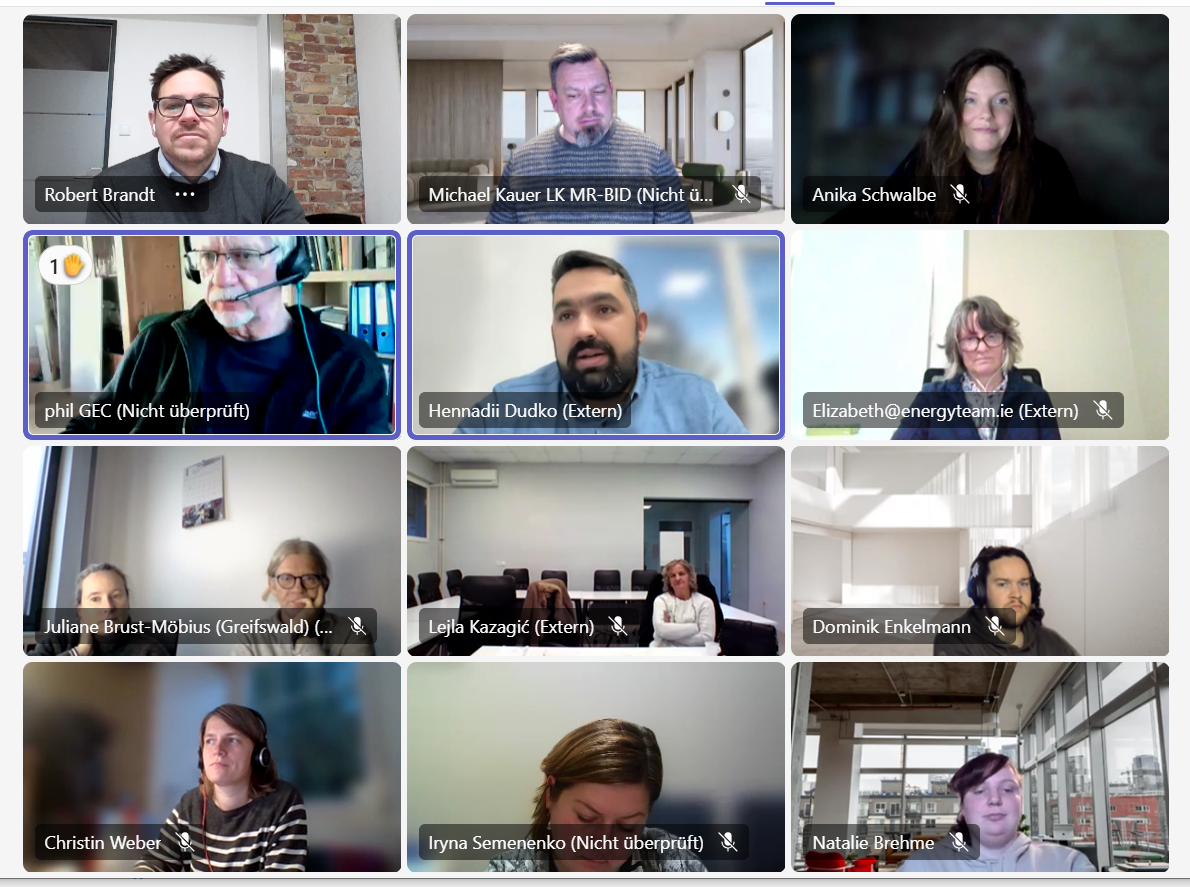 As part of the project “Energy Transition Town Twinning 3.0” (EWP
3.0), representatives from several European partner communities from
the last three funding rounds digitally came together on November 24, to
share practical experiences with citizen engagement, renewable energy
initiatives, and the infrastructural challenges facing their regions.
As part of the project “Energy Transition Town Twinning 3.0” (EWP
3.0), representatives from several European partner communities from
the last three funding rounds digitally came together on November 24, to
share practical experiences with citizen engagement, renewable energy
initiatives, and the infrastructural challenges facing their regions.
Philip James, a local representative from Galway, Ireland, opened the discussion by describing the context on the country’s west coast, where around 18.000 people live with a relatively low income and a highly centralized energy market, dominated by two or three major electricity companies. His citizen cooperative has been active for three years and relies on EU funding, similar in spirit to the cooperative model in Bavarian Pfaffenhofen, Galway’s twinning town from 2018 to 2021. During the active phase of their energy partnership, the cities were particularly interested in analysing how Pfaffenhofen managed to build its membership base, accumulate capital, and track revenues from its community-owned wind turbine. The benefits of citizen ownership have been substantial. According to the delegate, the challenge is not explaining cost savings – those are often clear – but developing effective mechanisms to engage residents. He also reflected on the broad potential of energy in multiple forms and noted that while heat can be shared, electricity sharing is more restricted.
Michael Kauer, climate protection manager from Marburg-Biedenkopf
district – which has been project partner with Koscierzyna, Poland from
2018 to 2021 – highlighted the strong volunteer base in his community,
where residents have initiated their own local district heating system.
Their previous partnership centred on sharing strategies for community-driven heating networks and the expansion of renewable heat sources. Kauer further explained that the local heating system relies on biomass and solar power.
Juliane
Brust-Möbius and Michael Haufe, representatives from Greifswald added
that they are in the midst of their heat-planning process. Their system
currently operates at a high temperature level, making the integration
of renewable sources more difficult. The city already uses waste heat,
solar energy biogas, large heat pumps with an output of around 2 MW, and
is exploring additional possibilities including photovoltaics and
water-powered turbines using river flow.
Since 2024, they have exchanged their challenges with Asima Džambegović and Lejla Kazagić from Goražde, Bosnia and Herzegovina, who also outlined the challenges in their community which faces financial constraints following the war limit investment capacity. Adding to these pressures, the town of 20,000 residents operates a water factory that requires substantial electricity.
In contrast, Galway is not affected by post-war conditions; however, the representative noted that the administration confronts related infrastructure issues. They referenced a €10 million Irish wastewater-to-energy initiative that combusts dried waste and produces more energy on average than it consumes. to generate a net energy gain.
Hennadii Dudko, Head of Strategic Planning and Financial Analysis Department in Chernivtsi, Ukraine, reported that the non-renewable energy share in his region remains around 60 percent. Biogas plays a role, but many power-generation facilities were destroyed, and wastewater systems require financial support. In times of war, Düsseldorf, their German partner in EWPS 3.0, supports the Ukrainian town with humanitarian aid and technical support. Since an official town twinning already existed before EWPS 3.0 started in 2024, it can be seen how an institutional partnership like the one of Düsseldorf and Chernivtsi can strengthen the energy partnership.
Elizabeth Kearney from the Irish Dunleer Energy Team emphasized the community-level perspective, including homeowners, community centres, and schools, and shared experiences from the partnership with Alheim, Germany. Back then, the partnership was founded on the shared goal of promoting energy-efficiency and the use of renewables in building refurbishments. She noted that housing types differ significantly between Germany and Ireland — a factor that strongly influences energy strategies. Further Dunleers outreach work has included school and community exhibitions, library activities, and extracurricular programming. A new initiative – the Northeast Climate Centre – will serve as a visitor centre and aims to reach decision-makers. She stressed the importance of climate action education and that students can be powerful multipliers who often influence families at home.
Last but not least, Iryna Semenenko, project manager from Novovolynsk, Ukraine, spoke about persistent electricity shortages in her community, mitigated partly through EU assistance. Access to many funds remains limited, and local partners are not always willing to participate. She highlighted mobility issues, including poor transport links to hospitals, but mentioned that electric cars could be a viable option. Her team plans to reconstruct their recovery centre and is inspired by concepts of vertical gardens from Hoyerswerda. Vice versa, Germany could learn from Ukraine’s progress in digitalization. Although the partnership is still young, small steps are underway.
Throughout the discission, insufficient funds were a reoccurring
topic. In the Moldovan city of Bălți – a EWPS 3.0 twinning town – a fast
transformation of heating is slowed down by persisting funding gaps,
too. Even Bălți’s twinning town Stuttgart, one of the richest cities in
southern Germany struggles with communal under-funding which has led to a
hiring freeze. Nonetheless, both towns continue with strategies to
educate their citizens and pupils at schools regarding energy transition
and started to work on the implementation of an energy directive and energy managers for the town of Bălți. To ensure a continuous transition, it is important to find ways to fund employees working on a town’s energy transition.
In concluding reflections, the spokesperson of Galway emphasized that Europe’s diversity – in technologies, opinions, and approaches – should be seen as a strength. Exchange like the one in that first workshop are essential for maintaining Europe’s position on the global stage of energy transition. He encouraged the group to explore EU instruments such as the LIFE fund or Erasmus to support continued collaboration in the field of energy transition. Importantly, he urged the participants to move beyond dialogue toward tangible project implementation to realize real and shared benefits. Next steps and specific approaches will be targeted in the upcoming workshops.
Social Media