
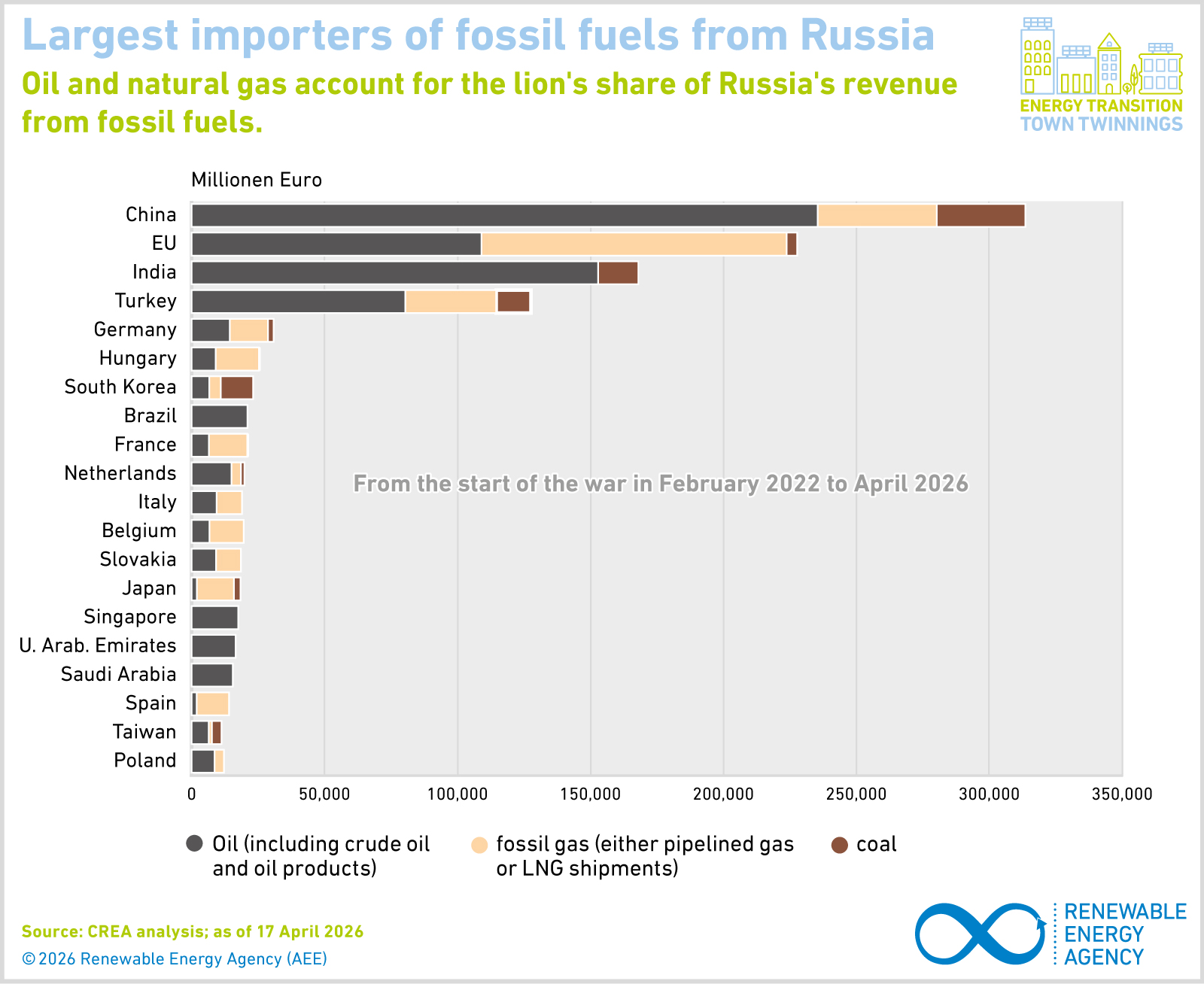
Largest importers of fossil fuels from Russia
The persistent neglect of redundancies in the energy supply sector is now taking its toll. The focus on cheap gas and fossil fuels is unsustainable. It is neither cost-effective nor a viable way to maintain peace through economic interdependence. It is clear that centralised energy structures are a risk in times of crisis. This has become apparent in the EU and the candidate countries on two separate occasions in the last four years. But what really protects democracy? Renewable energies are expanding and international and local partnerships are strengthening.
It is clear that both Russia's war of aggression and the armed conflict involving Iran make it obvious that dependence on fossil fuels from these countries also fills the war chests of these undemocratic regimes, thereby exacerbating the situation.
The EU is the second-largest importer of Russian fossil fuels (as of April 17, 2026). According to the Centre for Research on Energy and Clean Air (CREA[1]), an independent, non-profit research organization, it purchased Russian fossil fuels worth 228 billion euros. Gas accounts for the largest share at 50 per cent, followed by oil (47 per cent) and coal (3 per cent).
The use of the graphic is free of charge, as it was created as part of the Project Energiewende Partnerstadt 3.0.
Social Media